
$300 Billion Guarantees Drive AI Infrastructure Debt Boom
The latest Major technology companies are using guarantees to underpin a fast-growing debt market for data centres, advanced chips and computing equipment, with residual-value commitments reaching as much as $300 billion over the past year.
· Originally published by ontime+
Key Points
- Technology companies provided up to $300 billion in residual-value guarantees for AI infrastructure financing over 12 months.
- Special-purpose vehicles borrow for data centres and equipment, while corporate guarantees protect lenders against falling asset values.
- The model lowers financing costs but deepens exposure to demand weakness and rapid chip obsolescence.
The latest
Major technology companies are using guarantees to underpin a fast-growing debt market for data centres, advanced chips and computing equipment, with residual-value commitments reaching as much as $300 billion over the past year. Meta, Broadcom and Nvidia have backed structures that can lower project borrowing costs and limit debt recorded directly on corporate balance sheets, while leaving guarantors exposed if financed assets lose value.
Details
- Structure mechanics: A special-purpose vehicle borrows to acquire a data centre or costly computing equipment. The technology company guarantees part of the asset’s future value, protecting lenders if its market price is materially lower when financing matures. That support can secure cheaper funding without placing all underlying debt directly on the guarantor’s balance sheet.
- Pricing premium: Projects using these guarantees generally borrow at about 100 to 150 basis points above the guarantor’s own debt. The premium reflects asset risk even when the sponsor’s credit profile helps improve financing terms.
- Broadcom exposure: Broadcom assumed roughly $29 billion of exposure in June to support the sale of about 1GW of chips to a special-purpose vehicle. The vehicle will lease the equipment to Anthropic under a broader vendor-financing strategy developed with Google.
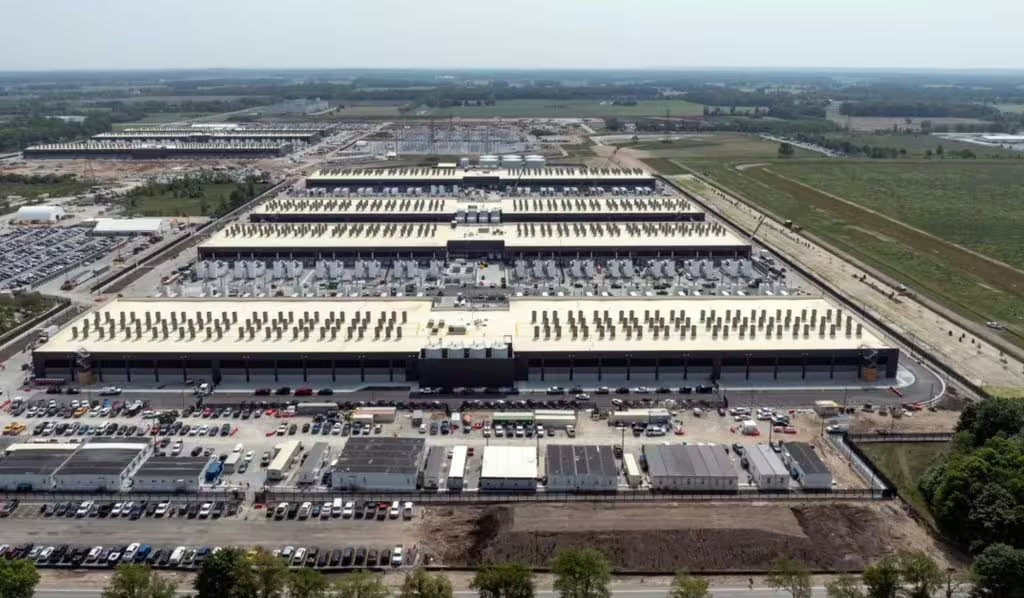
- Nvidia commitment: Nvidia provided about $105 billion in guarantees to SB Energy, a SoftBank subsidiary building an Ohio data-centre campus for OpenAI. The guarantee is not recorded as a balance-sheet liability until OpenAI’s leases begin in 2028, and the campus is expected to use Nvidia hardware exclusively for 20 years.
- Meta project: Meta provided a $28 billion residual-value guarantee for its Blue Owl joint venture involving Louisiana’s Hyperion data centre. The project spans roughly four million square feet, is expected online by 2030 and could require electricity comparable to consumption by about 1.5 million homes.
- Hidden commitments: Morgan Stanley analysts estimate seven major hyperscalers and chipmakers hold more than $3.1 trillion in off-balance-sheet commitments and credit support, a category broader than residual-value guarantees. S&P analysts incorporate stressed-sale values into leverage calculations, capturing exposure when guaranteed assets may fetch less than their financed value. The guarantees form part of a wider web of leases, credit support and long-term capacity contracts across the AI sector.
Between the lines
The central tension is between long-term infrastructure financing and the shorter technological life of AI hardware. Newer chips can deliver more computing power at lower cost, eroding older equipment’s value before debt matures. Slower AI adoption could also leave excess data-centre capacity while associated borrowing remains outstanding.
What’s next
OpenAI’s leases at the Nvidia-backed Ohio campus are scheduled to begin in 2028. Meta’s Hyperion project is expected online by 2030; those dates will test whether demand and asset values support the financing assumptions.