
After Sprint Record, China’s Humanoids Target Factory Floors
The latest Fresh from completing 100 meters in 8.64 seconds, TianGong Ultra is becoming a test of whether China’s humanoid robots can advance from competition spectacles to dependable work. Jack Guo, who leads development of Ultra and the…
Caroline Haiat · · Originally published by ontime+
Key Points
- TianGong Ultra completed 100 meters in 8.64 seconds at the World Humanoid Robot Games.
- Developer X-Humanoid is prioritizing reliability for factories, commercial services, inspection and emergency response.
- The next test is converting China’s hardware strengths into humanoids businesses can deploy at scale.
The latest
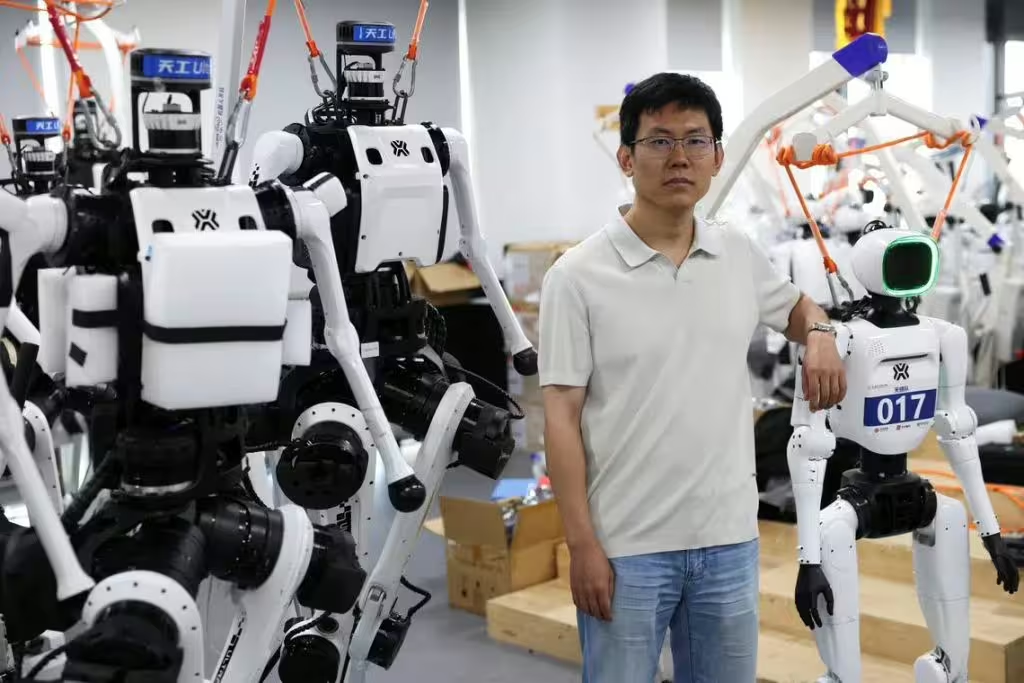
Fresh from completing 100 meters in 8.64 seconds, TianGong Ultra is becoming a test of whether China’s humanoid robots can advance from competition spectacles to dependable work. Jack Guo, who leads development of Ultra and the smaller TianGong Omni at X-Humanoid, said the aim is to turn “high performance into high reliability and high usability,” with engineers focusing on repetitive tasks that do not require constant human intervention.
Details
- Record progression: Ultra improved from 9.39 seconds in the preliminary round to 8.86 in the semifinal and 8.64 in the final. Its winning time was nearly one second below Usain Bolt’s 9.58-second human world record. The result followed overnight software adjustments, repeated testing and repairs by the engineering team.
- Design purpose: Weighing about 75 kilograms, Ultra can exceed 17 meters per second. It was built as a platform for testing humanoid movement limits, including high-speed balance and adaptation across different environments, rather than solely as a racing machine. Engineers compared movement-control strategies in simulations before choosing the competition systems.
- Race damage: The games also exposed the difficulty of sustaining performance. Some systems lost balance or crashed, forcing engineers to repair machines between races. Those failures reflect the practical problem Guo’s team is tackling: keeping a humanoid stable and productive through repeated operations rather than a single optimized demonstration.
- Practical trials: Omni climbed from the first floor to the 17th floor of X-Humanoid’s headquarters in an internal test. At a Foton Cummins engine factory in Beijing, the company’s Tianyi 2.0 robot moved boxes weighing eight to 12 kilograms and placed them on shelves, extending trials from mobility into material handling.
- Planned roles: X-Humanoid expects smaller humanoids eventually to work in light industry and commercial services, while larger platforms such as Ultra could handle outdoor inspection and emergency response. The company combines robotics hardware, motion-control systems and AI from its base in Beijing’s Yizhuang high-tech zone.
- Company backing: Established in 2023, X-Humanoid is backed by investors including UBTech, Xiaomi and Baidu. China’s broader manufacturing network covers motors, batteries, sensors, actuators and artificial intelligence, allowing domestic robotics companies to develop and revise hardware quickly. The commercial challenge is translating that base into systems businesses can use at scale.
Background
Guo compares current humanoids to early automobiles: developers must first master control of the body, then build more sophisticated AI capable of independent decisions and complex tasks. That sequence places speed as one development stage before robots can work alongside people for extended periods in unpredictable settings.
What’s next
The next indicator is whether factory and commercial trials can show robots repeatedly moving loads, navigating buildings and maintaining balance for long periods without constant human intervention—the threshold identified for scaled deployment.