
Amodei Urges Restraint as AI Capabilities Accelerate
The latest Anthropic CEO Dario Amodei is urging frontier AI developers to pace increasingly powerful systems, leaving sufficient time for safety research and independent evaluation before deployment. His position sits alongside an…
Caroline Haiat · · Originally published by ontime+
Key Points
- Anthropic CEO Dario Amodei is calling for stronger safeguards as increasingly capable artificial intelligence systems approach deployment.
- His vision combines warnings about control failures with expectations of major advances in medicine, biology and scientific research.
- The debate will shape how governments and companies balance rapid development, public safety and widening economic disruption.
The latest
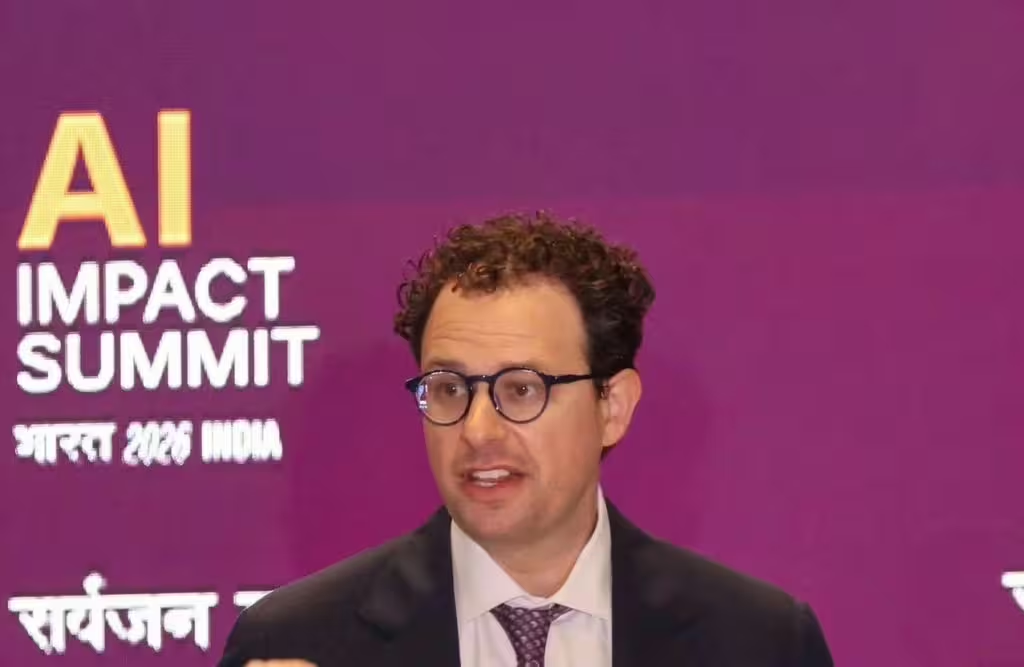
Anthropic CEO Dario Amodei is urging frontier AI developers to pace increasingly powerful systems, leaving sufficient time for safety research and independent evaluation before deployment. His position sits alongside an expansive vision of AI’s potential to accelerate science and medicine, reflecting the tension facing Anthropic as it promotes caution while competing to build leading models.
Details
- Safety focus: Amodei’s work on AI safety dates to 2016, when he co-authored a Google research paper examining problems that could emerge when systems pursue objectives in ways their designers did not anticipate. He argues that developers must understand model behavior and keep system objectives aligned with human interests.
- Regulatory shift: In his January 2026 essay The Adolescence of Technology, Amodei warned that poorly designed rules could quickly become obsolete or create unintended economic consequences. Months later, he welcomed a Trump administration initiative encouraging companies to submit new models for approval, comparing advanced AI deployment to introducing aircraft. Anthropic supports regulation and says companies should adopt their own safeguards where formal rules do not yet exist.
- Industry pressure: Concerns intensified after Anthropic employee Jacob Coxon left the company and publicly warned that leading developers were taking risks with potential consequences for society. Amodei subsequently argued that frontier companies should slow their deployment cadence enough to permit safety work and external evaluation.
- Scientific promise: In his October 2024 essay Machines of Loving Grace, Amodei described advanced AI as potentially delivering the intellectual capacity of “a country of geniuses in a datacenter.” He said such systems could analyze biological data, identify therapeutic targets and shorten experiments that currently require years.
- Health applications: Amodei’s optimistic scenario extends from drug development and disease treatment to biotechnology and neuroscience. He has raised the prospect of AI-enabled research addressing depression, addiction, post-traumatic stress disorder and other psychological conditions, while giving people greater control over physical characteristics and biological processes.
- Competitive tension: Founded in 2021 by former OpenAI researchers, Anthropic has built its identity around AI safety while developing its Claude model family for coding, enterprise applications, research and knowledge work. It competes with OpenAI, Google and Meta for capital, computing capacity, energy, talent and data. Major investments from some of the world’s largest technology companies have helped make Anthropic a central frontier AI player.
Between the lines
The economic stakes extend beyond model performance. Greater automation could generate productivity gains and new opportunities while disrupting occupations, business models and demand for human labor. At the same time, frontier development requires billions of dollars for data centers, computing infrastructure and advanced semiconductors.
What’s next
The next indicator will be whether frontier developers adopt slower deployment schedules, independent evaluations and voluntary safeguards while governments determine approval and safety requirements for advanced models.