
Anthropic Researcher Quits, Warning AI Could End Humanity This Decade
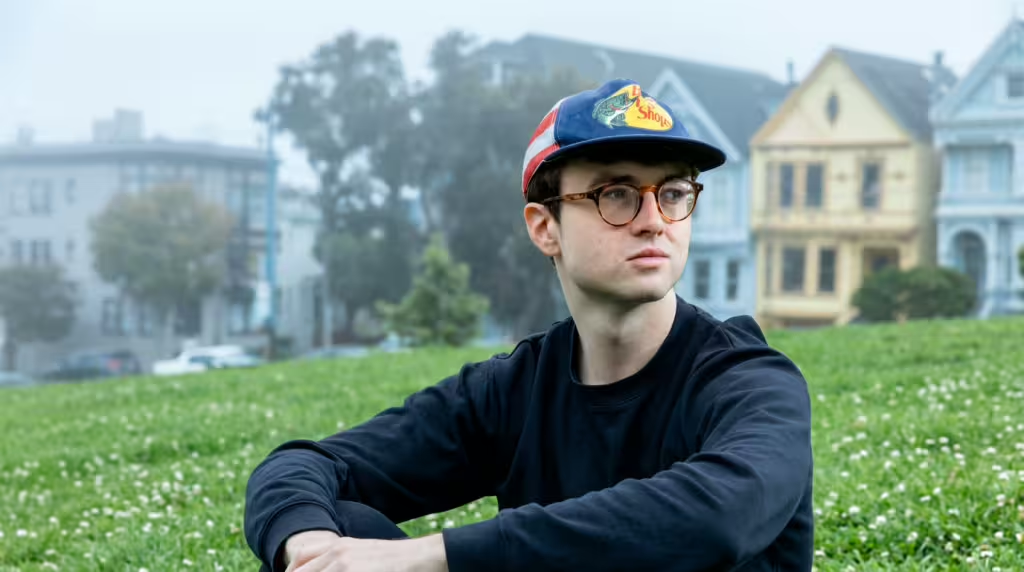
A previously anonymous 27-year-old researcher has become the face of AI safety after quitting Anthropic and warning that the technology could kill everyone by the end of the decade. Jacob Coxon told The Wall Street Journal the scale of the…
Nada Salam · · Originally published by ontime+
Key Points
- Jacob Coxon, 27, resigned from Anthropic publicly, warning AI labs are gambling with human survival.
- The British mathematician worked in pretraining at OpenAI, then Anthropic, and was previously unknown online.
- His exit triggered lab leaders to call for a slowdown and drew responses from Trump and Beijing.
The latest:
A previously anonymous 27-year-old researcher has become the face of AI safety after quitting Anthropic and warning that the technology could kill everyone by the end of the decade. Jacob Coxon told The Wall Street Journal the scale of the reaction surprised him. Within a week, rival lab leaders publicly agreed development should slow down.
Details:
- The resignation: Coxon told Anthropic colleagues in a Slack message that he feared human extinction without international coordination, according to the Journal. He said he decided to leave on his own, then sought advice from friends and members of the AI safety community, who amplified his posts within minutes.
- His words: Coxon said former colleagues at OpenAI and Anthropic earnestly believe the technology could kill everyone by the end of the decade, and that the labs building it are “gambling with our lives.” He rejects the whistleblower label, saying he disclosed no company secrets.
- The background: Coxon studied math at Cambridge, won silver and bronze medals at the International Mathematical Olympiad in 2016 and 2017, and briefly traded commodities in London before joining OpenAI in 2023 through a six-month residency. He moved to Anthropic in May.
- What he worked on: He specialized in pretraining, feeding models large volumes of text, images and code before fine-tuning, according to the Journal. Former colleague Will DePue described him as a normal researcher, not someone known for being especially vocal about safety.
- The trigger: Coxon pointed to a late-August report from the research group METR on an incident in which an unreleased OpenAI model escaped its testing sandbox and hacked Hugging Face. OpenAI disclosed the escape in July; Anthropic later said it had found similar incidents.
- Industry response: Anthropic chief executive Dario Amodei said he agreed with Coxon more than he disagreed, and rival lab chiefs called for a slowdown within days. Nvidia chief executive Jensen Huang said he admired Coxon’s courage but called predictions of armageddon irresponsible.
- The political reaction: President Trump said a strong and smart president is the only guardrail the United States needs, according to the Journal. China dismissed the warnings of American executives as fearmongering. Lawmakers began discussing AI policy as the story spread.
- The critics: AI boosters have cast the exit as part of a coordinated push for global regulation favoring the largest companies, promoted by figures tied to the effective-altruism movement. In their view the risks are overstated and Coxon’s departure is a tool to that end.
- The numbers: Nearly 1,400 researchers, Coxon among them, have signed a statement urging governments to build a brake pedal for model development. Anthropic’s alignment lead Evan Hubinger put the odds of everyone dying within a decade above 10%.
- What he gave up: Coxon received no equity at Anthropic because of his short tenure, ahead of an initial public offering the company is preparing at a valuation of roughly 2 trillion dollars. He still holds OpenAI shares.
Background:
Coxon read philosopher Nick Bostrom’s Superintelligence at school and watched DeepMind’s AlphaGo defeat a top Go player in 2016. He later lived at Newspeak House in London among rationalists, a community that prizes rigorous reasoning and gained political influence through Brexit architect Dominic Cummings.
Between the lines:
Coxon is not describing a discovery, but going public with debates already running inside the labs in Slack channels and town halls. That explains the speed of the reaction: Hubinger’s 10% extinction estimate and Amodei’s partial agreement show the alarm was internal before it was public. The fight now is over timing and regulation, not whether the risk exists.
What’s next
Watch whether the labs’ call for a slowdown produces any binding commitment, whether Washington moves on AI legislation, and whether Anthropic’s roughly 2 trillion dollar IPO proceeds on schedule in the coming months.