
Apple ships chatbot Siri as rival AI agents move past it
Apple released new smartphone software on Monday whose centerpiece is a rebuilt Siri that behaves like ChatGPT and Claude, holding conversations, drafting emails and answering complex search queries. The Wall Street Journal reported that a…
Nada Salam · · Originally published by ontime+
Key Points
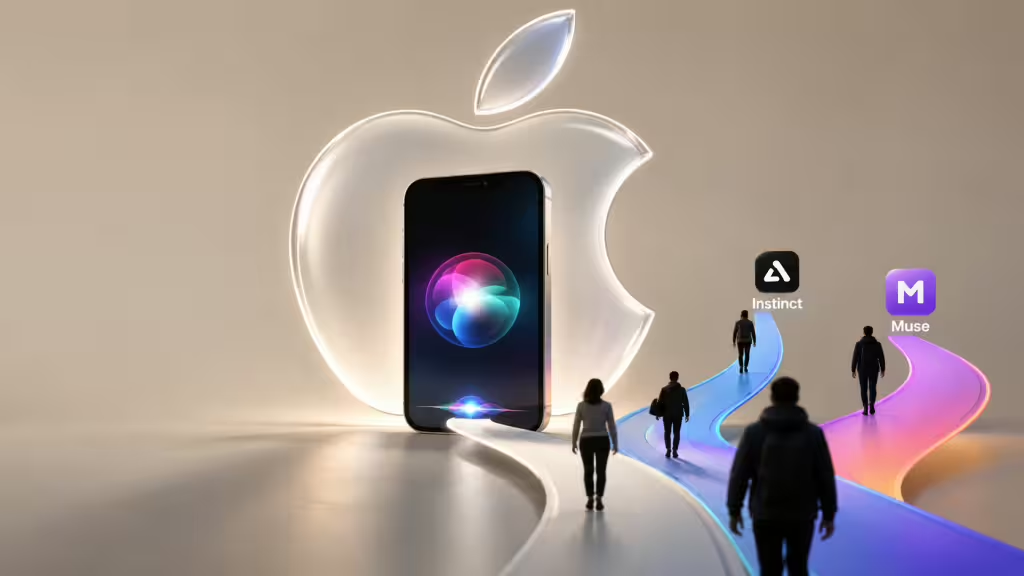
- Apple's new iPhone software features a redesigned Siri that converses, drafts emails and searches texts and photos.
- Rival AI assistants Instinct and Muse already book travel, fill out forms and complete multistep online tasks.
- The gap pressures new CEO John Ternus to turn Siri from chatbot into an agent.
The latest:
Apple released new smartphone software on Monday whose centerpiece is a rebuilt Siri that behaves like ChatGPT and Claude, holding conversations, drafting emails and answering complex search queries. The Wall Street Journal reported that a newer class of AI assistants has already moved past that standard by executing tasks on the open web, leaving Apple’s assistant behind the leading edge of consumer AI.
Details:
- What Siri does now: The redesigned assistant can hold a conversation, draft an email, search a user’s texts and photos, and handle complex search queries, according to the Journal. It is built to navigate iPhone apps rather than websites, and works best with Apple’s own applications.
- The app limitation: Some third-party developers have opened their apps to Siri, but several important ones have not, including Google. The Journal reported that means Siri cannot yet work seamlessly with Gmail, a gap rival assistants do not share.
- The rival startup: Instinct launched over the summer and is already valued at $2.5 billion, the work of an 11-person team building on an open-source Chinese AI model. The invitation-only service is surging in Silicon Valley because it does things Siri users have long requested.
- How Instinct works: The service runs outside Apple’s walled garden as cloud-based AI, connecting to accounts such as Gmail and chatting with users over iMessage or WhatsApp. It runs a virtual web browser in the cloud that visits sites to complete routine multistep tasks.
- The tasks: Instinct can spot conflicting travel bookings on a calendar and cancel and rebook them, surface local restaurant recommendations without searches through Google Maps or Yelp, and register for an obscure sports website, then pull game times into a personal calendar.
- Meta’s entry: Meta Platforms launched a comparable tool called Muse last week. SensorTower estimates it was downloaded nearly 600,000 times in its first five days, close to ChatGPT’s own debut pace, giving Meta a consumer footprint that can threaten Apple’s ecosystem directly.
- The Apple pitch: Ternus used his first public words as chief executive to describe the iPhone as an “intelligent personal hub” engineered for future AI experiences. He said rivals treat data as something to collect and store while Apple keeps user data private.
- The privacy tradeoff: Former Apple AI staffers told the Journal that the company’s privacy stance can slow product development and degrade the AI experiences it offers. They said consumers may be willing to share data with services that deliver large jumps in capability.
- The agent risks: Tools such as Instinct and Muse can see information inside a connected email account. The Journal cited fears they could delete emails, something Meta has said itself, or charge a credit card without authorization.
Background:
Apple first promised a smarter Siri well before this release, and the overhaul arrived under a new chief executive, John Ternus, who opened the company’s product event last Wednesday. The same event displayed the new foldable iPhone Duo.
Between the lines:
The Journal frames the commercial risk as an ecosystem problem rather than a feature gap. Buyers pay a premium for iPhones because hardware, software and apps are tightly coupled; if the most valuable assistant runs in the cloud and reaches users through iMessage or WhatsApp, as Instinct does, that coupling stops justifying the price. Cheaper Android phones, or skipped upgrades, become easier choices.
What’s next
Watch whether Google and other major developers open their apps to Siri, whether Siri gains the ability to act on websites rather than apps, and how Muse’s download pace holds after its first week.