
Oil Lifeline Under Threat: Yemen Escalation Risks Saudi Losses
SAFAA SUBHI · · Originally published by ontime+
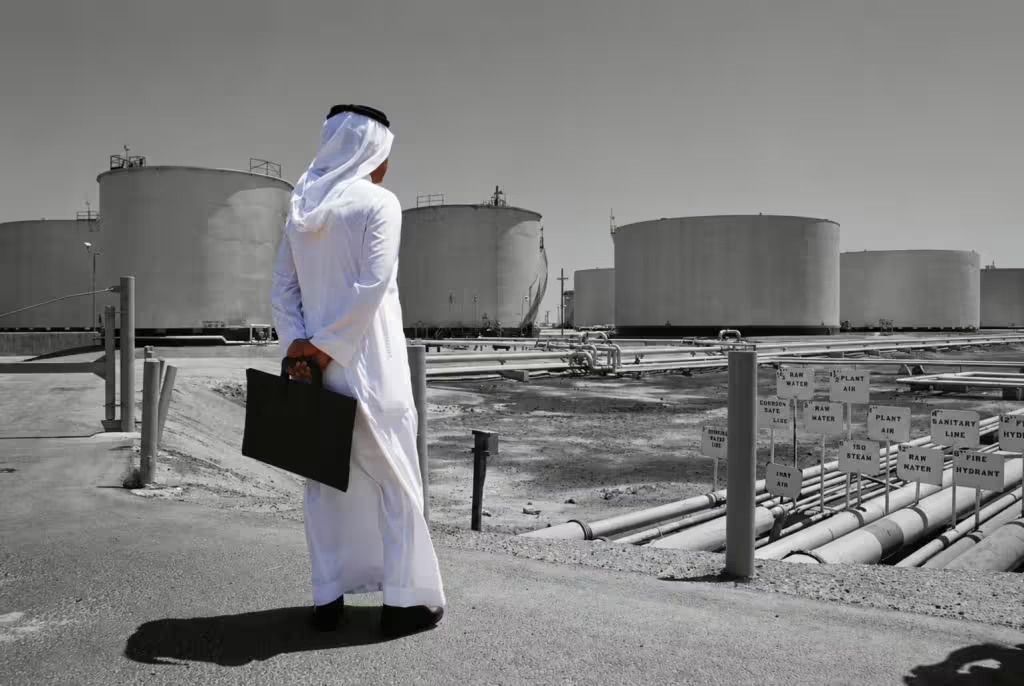
The latest:
Saudi Arabia is scrambling to reroute millions of barrels after shutting the East-West pipeline, the 750-mile line that became its main export artery once the war with Iran effectively closed the Strait of Hormuz in February. The New York Times reported the closure threatens to keep 4% of global oil supply off international markets. Riyadh said the shutdown was precautionary.
Details:
- The attack: Saudi Arabia announced the temporary closure on Friday after the pipeline was struck by an Iran-backed militia, according to The New York Times. The line runs from Abqaiq in the east to the Red Sea port of Yanbu, bypassing Hormuz entirely, and has been the kingdom’s principal export route since February.
- The damage: Satellite images taken on September 10 and 11 and reviewed by The New York Times show damage at two pumping stations. Saudi officials described the shutdown as precautionary without disclosing the extent of the damage or a restart timetable. Neither the Saudi government nor Aramco responded to requests for comment.
- The numbers: Kpler estimates the world could lose 120 million barrels of crude if the East-West line stays down for a month. Brent settled near $107 a barrel Wednesday, 50% above its pre-war level, and Goldman Sachs warned prices could reach $120 if attacks in the Gulf and Red Sea continue.
- The assessment: Amena Bakr, head of Middle East and OPEC+ insights at ship-tracking firm Kpler, called the situation unprecedented. She cited two blocked waterways, active attacks, escalating Iranian strikes, active proxies and no sign of diplomatic talks, describing it as “a catastrophic situation” through an energy-security lens.
- The counterview: Robin Brooks, a senior fellow at the Brookings Institution, said he does not believe nightmare scenarios in which the pipeline stays down for months, noting past repairs took weeks and satellite imagery already shows work underway. US Energy Secretary Chris Wright told CNBC Tuesday the disruption would be short and temporary.
- The precedent: Bakr estimated a full restart could take five to six weeks, with partial repairs far sooner. Aramco resumed pumping within days after a major Houthi attack on its facilities in 2019, and a pumping station struck in April, shortly after the war began, was back at full capacity within seven days.
- The escalation: Saudi Arabia and Yemen’s Houthis traded fresh accusations of attacks on Wednesday. The Houthis said they downed a Saudi warplane, while Riyadh claimed the group launched a drone near Mecca. The Houthis seized a strategic Red Sea port last week and struck Saudi energy facilities.
- The reserves: Saudi Arabia holds roughly 24 million barrels of storage capacity at Yanbu, but consultancy Rystad Energy estimated the port holds only three to six days of stock and said the tanks are unlikely to be full. Capital Economics said each week of closure with Hormuz shut would cut Saudi economic activity by at least 0.2%.
- The rerouting: Reuters reported Saudi Arabia is offering crude cargoes for export via Oman. Prices rose more than $3 in the previous session after shipping sources reported loadings suspended at Yanbu and some European-bound cargoes cancelled. Kpler said only two Saudi vessels have crossed the Red Sea since September 7.
- The traffic: Hormuz shipping has collapsed to about 20 vessels a day over the past week, against roughly 130 daily before the war, according to Kpler. The US Navy has kept some oil moving through lanes near Oman’s coast, an effort analysts described as large-scale and dangerous.
Background:
Aramco chairman Yasir al-Rumayyan said in June that engineers had expanded the pipeline’s capacity to as much as 7 million barrels a day, nearly 30% above pre-war levels. He traced the project to the 1980s, when Iran threatened to close Hormuz. Before the war, Hormuz carried a fifth of global oil supplies.
Between the lines:
Riyadh’s options are narrowing in both directions. With only two Saudi vessels crossing the Red Sea since September 7, analysts said the kingdom has begun routing ships back through Hormuz, where traffic has fallen to a sixth of pre-war levels. The Oman offer and the cancelled European cargoes point to the same constraint.
What’s next
Watch for an Aramco or Saudi statement on repair timelines, further satellite evidence of pumping-station work, resumption of loadings at Yanbu, and whether Brent breaches Goldman’s $120 threshold as Saudi-Houthi exchanges continue.