
OpenAI Acquires Glass Imaging at $300 Million-Plus Valuation
The latest OpenAI has quietly acquired Glass Imaging, an Israeli-founded computational photography startup, at a valuation exceeding $300 million, people familiar with the transaction said. The price is more than triple the roughly $100…
Caroline Haiat · · Originally published by ontime+
Key Points
- OpenAI has acquired Israeli-founded Glass Imaging in a deal valuing the startup above $300 million.
- GlassAI improves compact-camera images by processing raw data and correcting optical and sensor flaws.
- The purchase adds computational photography expertise as OpenAI expands from cloud software toward consumer hardware.
The latest
OpenAI has quietly acquired Glass Imaging, an Israeli-founded computational photography startup, at a valuation exceeding $300 million, people familiar with the transaction said. The price is more than triple the roughly $100 million valuation Glass reached in its previous funding round. The purchase brings OpenAI technology designed to improve images from compact cameras, along with a team whose founders helped develop Apple’s iPhone Portrait Mode, as chief executive Sam Altman pursues consumer hardware projects with former Apple design chief Jony Ive.
Details
- Apple veterans: Glass Imaging was founded in 2019 by Israeli entrepreneur Ziv Attar and Tom Bishop, both former Apple engineers. They developed the company around the view that smartphone photography was approaching the limits of improvements achievable through larger sensors, extra cameras and increasingly sophisticated lenses.
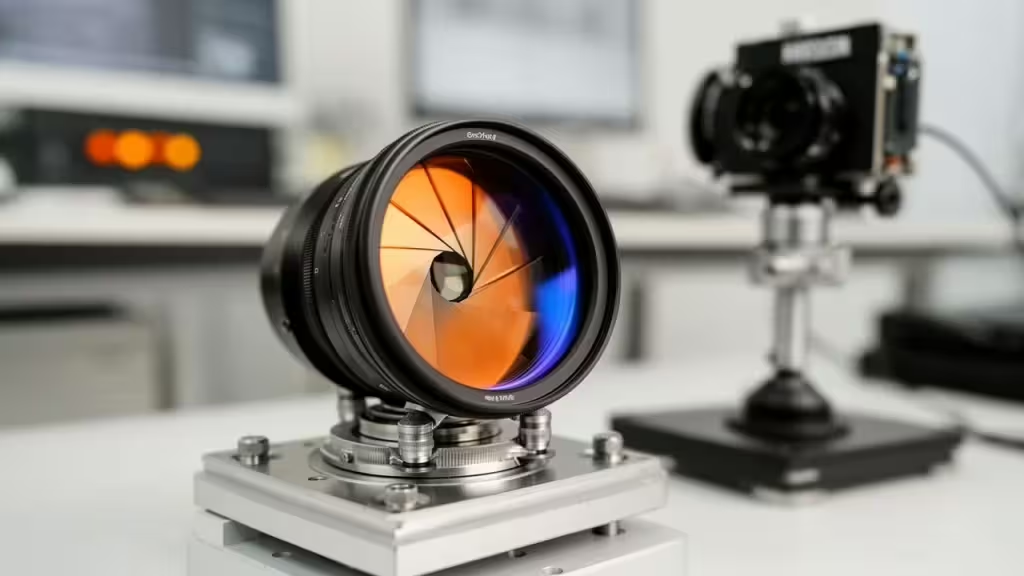
- Image processing: Its GlassAI technology processes raw image data to correct optical aberrations, sensor imperfections and digital noise while reconstructing fine textures. Glass said in a 2025 announcement that the technology could potentially deliver a tenfold improvement in camera performance.
- Captured detail: Glass describes its approach as computational photography rather than generative image manipulation. Its objective is to produce sharper, more detailed photographs while preserving information captured by the camera instead of inventing new visual elements.
- Device applications: The technology has been developed for smartphones, drones and connected devices. GlassAI can run through embedded AI, enabling image processing directly on hardware rather than requiring every image to be transmitted to a remote data centre.
- Visual interface: Cameras could become a central interface for AI-native consumer devices. More sophisticated imaging could help systems interpret objects, environments, documents and people more accurately, making visual input a fundamental component of assistants designed to understand their physical surroundings.
- Hardware expansion: OpenAI acquired Ive’s hardware startup, io Products, for $6.5 billion in 2025. Ive, a leading figure in Apple’s rise as a consumer technology company, is now collaborating with OpenAI on a secretive device and other hardware projects.
- Funding trajectory: Glass raised $20 million in a Series A round led by Insight Partners in May 2025, with participation from GV, Future Ventures and Abstract Ventures. That followed a $9.3 million extended seed round in 2024 and an earlier investment led by LDV Capital in 2021.
Background
The acquisition comes as AI companies increasingly explore edge computing, which moves processing onto devices instead of relying entirely on cloud infrastructure. Local image processing can support speed, connectivity, privacy and power consumption as companies seek control over models, chips, infrastructure and consumer devices.
What’s next
The next concrete indicator will be OpenAI’s disclosure of whether GlassAI will support the device being developed with Ive, another hardware project or a separate application.