
US and Iran give clashing accounts of Hormuz tanker blast
SAFAA SUBHI · · Originally published by ontime+
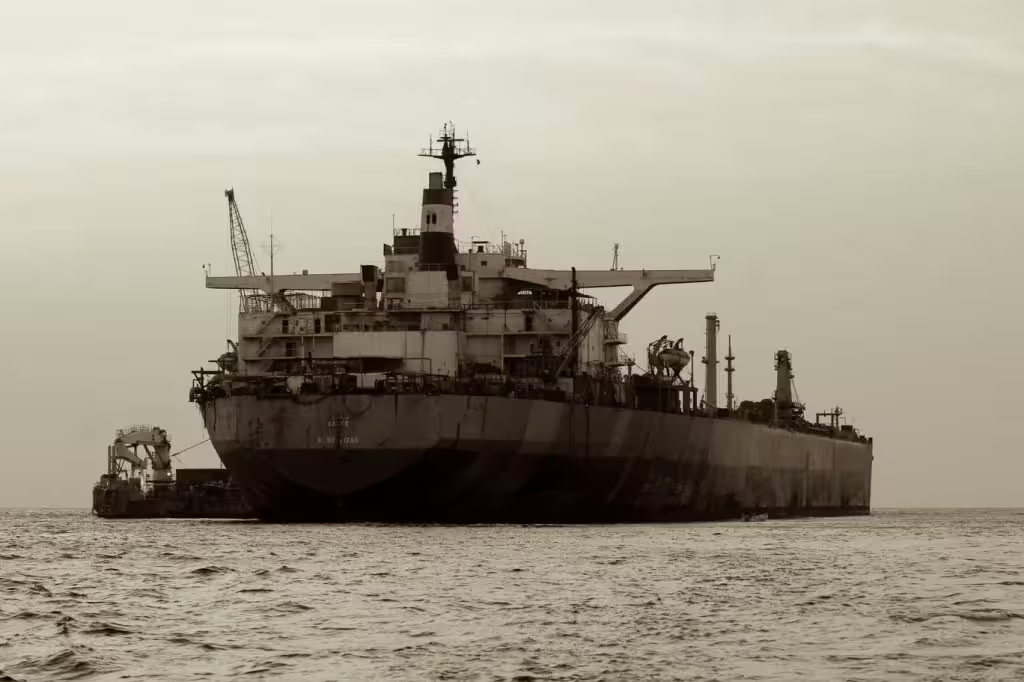
The latest:
A Panama-flagged oil tanker is burning near the Strait of Hormuz, with Washington and Tehran offering irreconcilable explanations for how it was crippled. Iran’s Revolutionary Guard navy said the El Jaya detonated a naval mine while entering a zone closed to shipping. US Central Command called that account false and said Iranian forces struck the vessel twice.
Details:
- The Iranian account: The Revolutionary Guard announced Monday evening that the El Jaya exploded after hitting naval mines while attempting to pass through a navigation-restricted area south of the Strait of Hormuz. Its naval command said efforts to contain the fire failed and the entire tanker caught ablaze.
- The US denial: Central Command said the tanker was disabled by an Iranian missile last month, then targeted again by an Iranian drone over the weekend while anchored off the Omani coast. It described the mine version as false and part of an effort to mislead and intimidate commercial shipping.
- The vessel’s trail: Ship-tracking site VesselFinder recorded the tanker last on 5 September, anchored at Sohar port in Oman, with its transponders apparently switched off since then. Central Command said the vessel is now under tow by a regional partner.
- Tehran’s warning: Iran said repeated warnings had been issued about the danger of what it calls an illegal route, and its Revolutionary Guard navy asserted that the Strait of Hormuz is closed and under full Iranian control — a claim that goes beyond the incident to the status of the waterway.
- Second incident: Iran’s Fars news agency reported shortly afterward that two fishing boats were hit by a drone near Bandar Khanjan in the Gulf. Fishermen aboard both vessels were reported missing and search-and-rescue operations were launched. No party was named as responsible.
- Diplomacy stalls: Iranian and Gulf representatives were due to meet in Oman on reopening Hormuz to regular tanker traffic. Omani Foreign Minister Badr al-Busaidi announced a postponement, with the foreign ministry saying the aim was to create conditions for constructive dialogue.
- Competing explanations: Al Jazeera quoted a senior Iranian foreign ministry official saying the delay came at the request of some regional states and was a joint Tehran-Muscat decision. Qatari Prime Minister Mohammed Al Thani and Saudi Foreign Minister Faisal bin Farhan held calls before the cancellation.
- Gulf coordination: Bin Farhan also spoke with Emirati Foreign Minister Abdullah bin Zayed. The Saudi foreign ministry said the two discussed regional developments and efforts to curb escalation, stressing unified positions and the protection of Gulf states’ security and resources.
- Oil reaction: Reuters reported crude settled around 1% higher Monday on supply fears after fresh attacks on Saudi energy infrastructure and on shipping. Both benchmarks had surged close to 5% before retreating when President Donald Trump said Iran wants a deal with Washington.
- The numbers: Brent futures rose 1.07 dollars, or 1.0%, to settle at 105.68 dollars a barrel. US West Texas Intermediate gained 1.34 dollars, or 1.3%, to close at 101.39 dollars.
Background:
Quiet talks in recent months, led by Oman, have explored a legal framework to restore commercial traffic through Hormuz, which remains far below pre-war levels. Gulf states are simultaneously expanding alternative export routes that bypass the strait.
Between the lines:
The two accounts are not a detail dispute: a mine implies a hazard in a zone Tehran says it controls, while a missile and drone imply direct targeting of a commercial vessel. Central Command frames the Iranian version as intimidation aimed at shipping. The postponed Oman meeting and the parallel push for bypass routes suggest the region is treating restricted navigation as a risk it will not normalize.
What’s next
Watch for a rescheduled date for the Iran-Gulf meeting in Oman, the outcome of the towing operation and search for the missing fishermen, and whether crude holds above 100 dollars if further attacks follow.