
U.S. Admits It Has Deployed Weapons in Space
SAFAA SUBHI · · Originally published by ontime+
The latest:
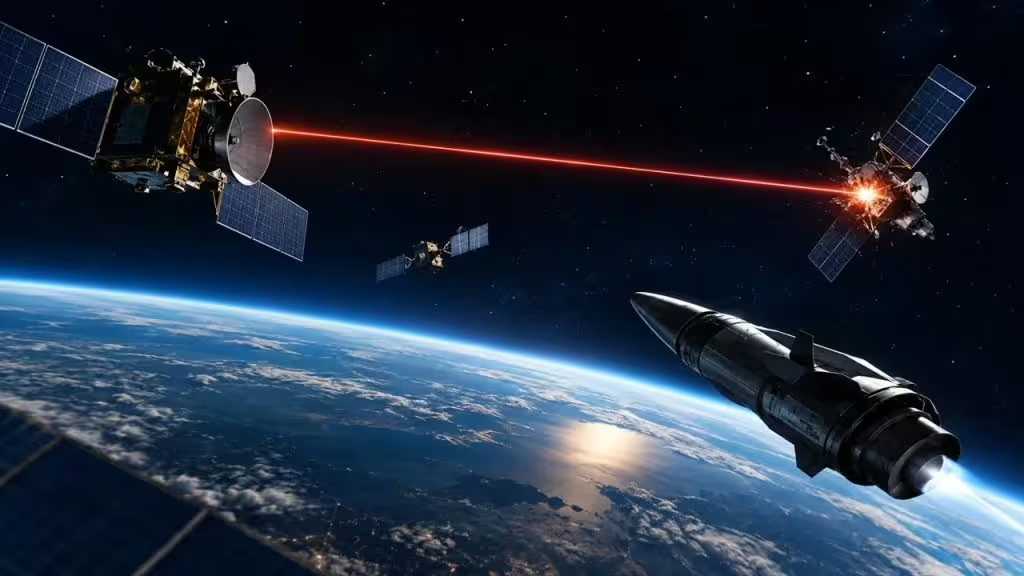
The United States has weapons in orbit capable of defending joint forces against hostile adversary actions, Air Force Secretary Troy Mink said Monday at a conference in Maryland, according to a service press release. It is the first such public acknowledgment by a Pentagon official. Mink gave no detail on what the weapons are, how they work, or when they were deployed.
Details:
- The statement: Mink told the Air, Space and Cyber Conference in National Harbor, Maryland, that Washington is raising its readiness against current threats and that the US has “space-control weapons in orbit capable of defending the joint force against hostile adversary actions,” according to the Air Force release.
- The gaps: Mink did not identify the type of weapons, their capabilities, or when they were placed in orbit. The Associated Press reported he also did not explain how they function. The Space Force did not immediately respond to a request for comment late Monday, according to The New York Times.
- The venue: The remarks came in a keynote at the annual forum hosted by the Air and Space Forces Association, a nonprofit for members of both branches — a service conference rather than a formal policy rollout or congressional testimony.
- China’s response: Chinese foreign ministry spokesman Guo Jiakun, asked Tuesday about Mink’s comments at a regular briefing, said Beijing opposes an arms race in outer space and urged Washington to stop expanding its military forces and preparing for war there.
- The threat picture: The Pentagon has long feared Chinese and Russian space advances that could threaten American ground forces and satellites. In 2024, the Times reported US intelligence assessed Russia might plan to place a nuclear weapon in space; the White House said then the danger was not imminent.
- Why satellites matter: Much US infrastructure depends on satellite communications, and orbital networks underpin everything from civilian connectivity to military operations — the reason an anti-satellite weapon is treated in Washington as a strategic rather than a narrow military problem.
- The weapons history: The US, Russia and China began testing satellite-destroying weapons decades ago, but Washington later disavowed them because they scatter orbital debris. The Air Force has since moved toward low-debris weapons able to disable or impede hostile satellites, former Air Force Secretary Frank Kendall told the Times in 2024.
- What they might be: Neither Kendall nor General Chance Saltzman specified how the systems work. Other former Pentagon officials said they would likely involve lasers, high-powered microwave systems, or American satellites able to grab or move adversary satellites, according to the Times.
- The timeline: Saltzman, chief of space operations under Biden and into Trump’s second term until retiring last month, told a Senate panel in 2023 that new space weapons systems would be fully operational by 2026.
- Golden Dome: Shortly after returning to the White House last year, Trump signed an executive order expanding US air defenses, including space-based interceptors. The project, Golden Dome, targets weapons such as the hypersonic missiles Russia has deployed in Ukraine. In May, Trump said General Michael Guetlein would oversee it.
Between the lines:
Kendall’s 2024 remarks that space can be used for military advantage, and Saltzman’s 2026 operational target, suggest Mink disclosed a program already years in motion rather than a new capability. The absence of any deployment date, weapon type or Space Force comment leaves the scale of what is in orbit unclear.
What’s next
Watch for Space Force clarification, congressional questioning on the disclosure, and whether Beijing or Moscow follows its rhetorical objection with a concrete step. Golden Dome’s space-based interceptor work under Guetlein is a separate track.